Measles, the MMR Order, and What Doctors Owe After Being Wrong

In the spring of 2020 I told families things with more confidence than the evidence supported.
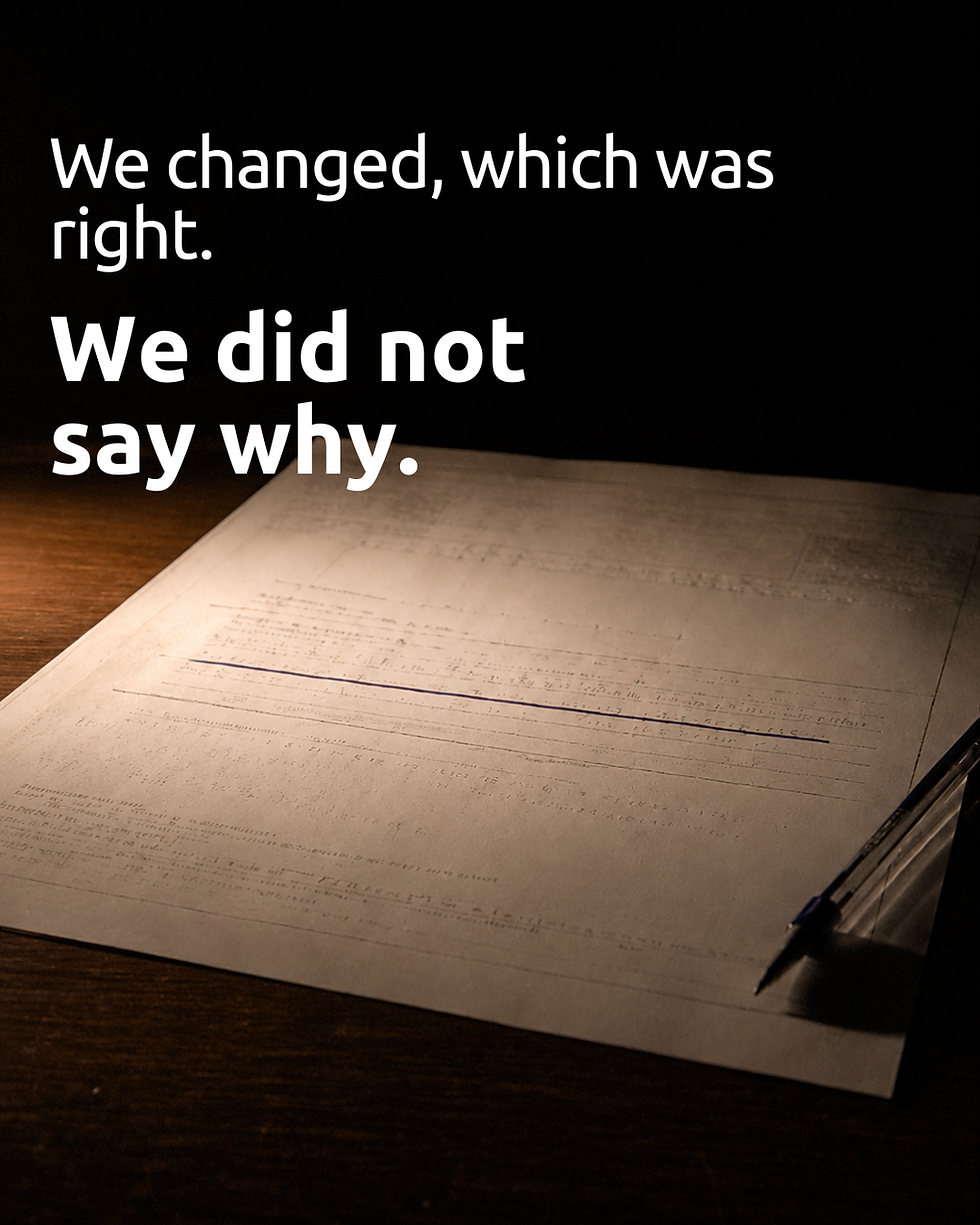
Not lies. Best available understanding, delivered in a firm voice, because a firm voice is what you reach for when a family is terrified and you have ninety seconds. Some of it did not hold up. Guidance moved under us on transmission, on masks, on steroids, on when to intubate and when to wait. We changed, which was correct. We changed without always explaining why, which was not.
The Government Accountability Office put this in writing in November 2020. In GAO-21-191, auditors found CDC testing guidelines had changed repeatedly with little scientific explanation, raising the risk of confusion and eroding trust in government. They recommended HHS require CDC to disclose its reasoning whenever guidance changed. HHS concurred.
That is a dry sentence about something that happened to real people, who then decided, not unreasonably, that they were being handled.
We already have a rule for this in medicine, and it is a good one. You are not allowed to erase in a medical record. When you get something wrong you draw a single line through it, write the correction beside it, and initial and date the line. Anyone reading later sees what you thought, what you changed it to, and exactly when you stopped believing the first thing. The error stays legible on purpose.
Every clinician understands the logic, because we do it daily. I change a plan when the lactate rises, when the pressure will not hold, when the repeat scan shows what the first one missed. Nobody calls that lying. We call it responding to information. During COVID the same process ran in public, at speed, under fear, for an audience that had never been shown how it works.
Science informs policy. It does not make policy. Whether to close schools was never a purely scientific question. It involved transmission and also food security, mental health, working parents, and which harms a society will absorb. Those are value judgments. We handed some of them over wearing a lab coat, and when they proved contestable, people concluded the science was fraudulent rather than the values debatable.
A category error, made under pressure, at scale. It cost us.
Trust is not obedience
I am not asking for belief. I am asking for enough trust to examine you, take a real history, order the right tests, consider the diagnoses I do not want to be true, and say where my knowledge stops.
That is a claim about method, and methods can be audited. Did she listen? Did she examine me? Did she explain the reasoning or only the conclusion? Did she name her uncertainty before I asked? Did she change course when the labs came back? Did she own it when she was wrong?
Hold me to all six. That standard is more demanding than blind faith, and it is the only kind of trust worth having.
An AI cannot meet that standard. It cannot examine you, cannot be surprised by how you look when you stand up, and cannot answer to you afterward. Neither can an influencer, whose video stays up either way.
I carry the outcome. That makes me answerable, not right.
Measles in 2026, and the number I used to get wrong
As of August 13 the CDC has confirmed 2,566 measles cases across 45 jurisdictions and 38 outbreaks, already past last year's 2,289. Both are the highest since 1991. About 93% of cases are in people unvaccinated or of unknown status, and roughly two thirds are children and young adults under twenty.
The country was declared measles-free in 2000. In August 2026 the United States National Verification Committee reviewed the data and forwarded its assessment to the Pan American Health Organization, which announces its determination in November. Noel Brewer, who chairs that committee, wrote before the meeting that the public numbers show a runaway train.
I used to explain this by saying national MMR coverage is 92.5%, herd immunity needs 95%, so we are three points short. I stopped, because it makes the problem sound smaller and more evenly distributed than it is.
Measles does not infect a national average. It infects a room.
State coverage last school year ran from 78.5% in Idaho to 98.2% in Connecticut, and inside a state it splits again by county and by school. Gaines County, Texas sat at the center of last year's outbreak and has three school districts. Seagraves had 94% of its kindergartners vaccinated against measles. Seminole had 82%. Loop, all 143 students of it, had 46%, and roughly 48% held conscientious exemptions, the highest rate in Texas. Nationally, about 286,000 kindergartners started last year with no record of a completed MMR series.
A single school in the forties can seed an outbreak in a state averaging in the nineties. Averages are very good at hiding the clusters that spread disease.
There is a coda, and it does not resolve cleanly. After the outbreak, Gaines County kindergarten coverage rose to 80%. Real movement, still fifteen points short. Across Texas that same year the exemption rate rose to 4.45%, the largest single-year jump in more than a decade. A deadly outbreak moved its own epicenter a little and moved the rest of the state the other way.
What the MMR executive order would actually do
On August 10 the President signed an executive order calling for the combined MMR shot to be given as three separate single-disease injections at three separate visits, urging states to revisit school vaccination laws, and directing the Justice Department to challenge state rules on religious and medical exemptions.
The facts around it, plainly. No new scientific evidence accompanied the order. Single-disease measles, mumps, and rubella vaccines do not currently exist in the United States, and manufacturers would have to run trials to bring each one through approval. Major insurers have said they will keep covering the schedule for now. Legal challenges are expected.
Set the politics aside and look at the mechanism, because the mechanism is the part I actually know something about.
At a four-year well-child visit we typically give two injections. Pull every combination apart and that becomes five to nine, with the family returning every couple of weeks to finish. The average wait for a new patient appointment across fifteen of the best-supplied metro areas in the country is 31 days.
Now ask what happens to a series that requires four more trips from a parent who could not manage one.
Cyclospora: follow one case backward
Then there is Cyclospora, which has no vaccine, no faction, and no cable segment. The cleaner test of everything I have argued.
A woman in Michigan has watery diarrhea that will not stop. Three weeks of it. Her physician orders a stool study, and in a lab someone puts the specimen under ultraviolet light, where Cyclospora oocysts autofluoresce a distinct blue, and writes it down. The result goes to a county health department, then the state, then a national reporting system, because cyclosporiasis is notifiable and someone decided decades ago that it should be.
An epidemiologist notices Michigan's count is wrong for the season. Then Ohio's. Interviewers start calling the sick to ask what they ate, worse work than it sounds, because nobody remembers lunch from eleven days ago. Michigan pulled food histories from 190 cases and found the overlap. Traceback followed shredded iceberg lettuce to Taylor Farms de Mexico. On July 17 it was recalled.
Most people were already sick by then. As of August 13 the outbreak stood at 9,481 illnesses across seventeen states with at least 398 hospitalizations, and two deaths in Michigan, both in people with serious underlying conditions, both of whom fell ill before the recall. The last reported onset was August 3.
One more thing happened inside that chain and I want it on the record. In mid-July the FDA reported a Cyclospora-positive sample collected at the border. The next day it withdrew the result as a false positive. The case held anyway, on epidemiology, because ninety percent of interviewed patients had eaten iceberg lettuce and the supply lines converged on one supplier.
That is what showing your work looks like when it is inconvenient. An agency published a finding, retracted it within a day, and the conclusion survived without it.
Count the strangers in that chain. The lab tech, the county nurse, the state epidemiologist, the interviewer with the food questionnaire, the traceback investigator, the person at a produce company who agreed to pull inventory off shelves and eat the cost.
You cannot verify one of them. Neither can I. Public health runs on that chain being credible, and credibility is not something you can build during the outbreak that needs it.
What would change my mind
I have spent three parts arguing that the test of any claim is what would falsify it. It would be cheap to finish without answering it about my own.
My claim is that the strongest protection against health misinformation is an accessible, accountable clinician who knows you, and that no campaign or fact-check comes close.
Here is what would break it. If that KFF gap closed, and people with a trusted provider endorsed false claims at the same rate as people without one, my argument is finished. If a well-designed trial showed a public education campaign outperforming continuity of care, I would have to concede the relationship is sentiment and the campaign is the medicine. And if the gap is pure selection, if the sort of person who keeps a doctor already resists conspiracy, then I have mistaken a marker for a mechanism.
I do not believe any of those. I could be wrong about all three, and now you know where to look.
What I keep coming back to
We cannot control a Senate hearing or a Sunday show or an order signed in the Oval Office. That fight is not winnable on those terms, and I have watched colleagues exhaust themselves trying, usually by posting something clever about how stupid patients are, which is its own small betrayal.
What we can control is smaller and more durable. The visit itself. The family meeting where somebody turns a phone around, or the conversation outside the ICU at two in the morning, where the daughter is not really asking about ventilator settings and you have to stay quiet long enough to hear the actual question.
There are 1,082,187 licensed physicians in this country. Almost none of us are on television. Most of us get it right most of the time, using evidence built by people whose names we will never learn.
The answer to medical distrust was never going to be "trust us."
It is this: here is what we know, here is how we know it, here is what we do not know, and here is exactly what would change our minds.
That is not a retreat from authority. It is the only kind of authority that ever deserved the name.
Questions I keep getting
Does the executive order change what vaccines my child can get right now?
No. The federal childhood immunization schedule is unchanged, and an executive order is not a rule. Single-disease measles, mumps, and rubella vaccines are not manufactured in the United States, so there is nothing to switch to even if you wanted it. Blue Cross Blue Shield and Aetna have both said they will keep covering CDC-recommended pediatric vaccines without a copay, and the Vaccines for Children program is unaffected because it takes its guidance from the CDC advisory committee. If your child is due for an MMR, they can have one.
Has the United States lost its measles elimination status?
Not yet, and the decision is not ours to make. The United States National Verification Committee reviewed the 2026 data in August and forwarded its assessment to the Pan American Health Organization. PAHO's Regional Verification Commission announces its determination in November 2026. Elimination requires twelve consecutive months without continuous domestic transmission, and outbreak-linked spread has continued all year.
How many measles cases are there in the United States in 2026?
As of August 13, 2026, the CDC has confirmed 2,566 cases across 45 jurisdictions, with 38 outbreaks. That already exceeds the 2,289 cases recorded in all of 2025, and both figures are the highest annual totals since 1991. About 93 percent of cases are in people who were unvaccinated or whose vaccination status is unknown, and roughly two thirds are children and young adults under twenty.
Is spacing childhood vaccines out across more visits safer?
No evidence supports it. The argument usually rests on the idea that the modern schedule overloads a child's immune system, and the antigen count runs the other way: the whole-cell pertussis vaccine used on its own in the 1980s contained roughly 3,000 antigens, while the entire schedule today contains fewer than 160. What spacing reliably adds is visits, and every added visit is another chance for a series to go unfinished.
What is the measles vaccine's actual effectiveness?
One dose of MMR is about 93 percent effective at preventing measles and two doses about 97 percent. Community protection requires roughly 95 percent coverage. National kindergarten coverage sits near 92.5 percent, but the national figure hides the clustering that actually drives outbreaks, which is the point this piece spends most of its length on.


Comments